Imagine spending an entire week researching prospects, building lead lists, and sending personalized LinkedIn messages.
You've contacted 200 people. Some accepted your invitations, a few replied, but almost none showed genuine interest in your product.
Your first instinct might be to rewrite the messages.
Maybe the opening wasn't engaging enough. Maybe the offer wasn't clear. Or perhaps you simply need to contact more people.
But what if the real problem started before you sent the first message?
You might be reaching out to companies that were never a good fit for your product.
That's exactly what an Ideal Customer Profile (ICP) is supposed to help you avoid.
A well-defined ICP makes prospecting more focused, helps you understand why certain companies are worth approaching, and gives your outbound strategy a clearer direction.
The challenge is that many businesses define their ICP too broadly to make it useful.
Let's look at how to build one that actually helps you find potential customers.
What Makes an ICP Useful?
An Ideal Customer Profile describes the type of company that is most likely to benefit from your product and become a valuable customer.
It usually includes characteristics such as company size, industry, location, business model, and the problems your solution addresses.
For example, a basic ICP might look like this:
B2B SaaS companies with 1–50 employees in the United States.
That's a reasonable starting point.
But it doesn't explain why those companies need your product.
A company with five employees and a founder handling sales independently may have completely different challenges from a 50-person business with an established sales team.
Even though both fit the same description, they might need different solutions.
A more useful ICP goes beyond identifying what a company looks like.
It also helps you understand:
- What problem is the company trying to solve?
- What makes that problem relevant to your product?
- Who inside the company is responsible for solving it?
- Does the company have the resources and motivation to act?
- What would make it a poor fit?
The best ICP isn't necessarily the most detailed one. It's the one that helps you make better prospecting decisions.
If your sales team can use it to decide which companies deserve attention and which should be excluded, you're moving in the right direction.
ICP vs. Buyer Persona: What's the Difference?
These two terms are often used together, but they answer different questions.
Your ICP describes the company you want to work with.
Your buyer persona describes the person you need to reach within that company.
Let's take a B2B sales automation product as an example.
Your ICP might include small B2B SaaS companies that have already started outbound sales but don't have a dedicated sales development team.
Your buyer persona could be a founder who personally handles prospecting and wants to spend less time researching leads and managing follow-ups.
The company is a potential fit because of its business needs.
The founder is the person experiencing those needs and potentially making the purchasing decision.
This distinction becomes especially important when you're building a lead list.
Finding someone with the title Head of Sales doesn't automatically mean they're a good prospect.
You still need to understand whether their company fits the product you're selling.
Similarly, finding a company that looks perfect on paper doesn't tell you who should receive your message.
Good outbound requires both: the right company and the right person.
Start With the Customers You Understand Best
Before adding dozens of filters to your prospecting tool, look at the information you already have.
If your business has existing customers, start with those who have received meaningful value from your product.
They may reveal patterns that aren't obvious from company descriptions alone.
Ask yourself:
- Which customers use our product consistently?
- Which ones have achieved the outcomes they expected?
- What problems motivated them to buy?
- How long did it take them to make a decision?
- Which customers required significant customization or support?
Don't simply select your biggest customers.
A large customer paying more money might also require expensive implementation, unusual product features, or months of sales conversations.
For a small startup, a slightly smaller customer who gets value quickly and stays engaged could be a better example of product fit.
What if you don't have customers yet?
This is a common situation for early-stage B2B startups.
You can't analyze successful customers if you haven't acquired them.
But you can still create a useful starting hypothesis.
Begin with the problem your product solves and work backward.
Imagine you're developing a tool that helps founders automate parts of LinkedIn prospecting.
Instead of targeting everyone involved in B2B sales, consider companies where:
- The founder is still personally involved in finding customers.
- Outbound is already part of the sales process.
- Prospect research and follow-ups consume significant time.
- The company wants to increase sales activity without immediately expanding its team.
You now have something more specific than a list of industries and job titles.
You have a hypothesis about who experiences the problem and why they might need your product.
That hypothesis isn't proven yet.
Your next step is to test it through conversations with potential customers.
Five Questions That Make Your ICP Actionable
You don't need a complicated document to define your first ICP.
For an early-stage B2B company, answering five practical questions can be enough to start.
1. Which companies can realistically use your product?
Start with the basic characteristics that influence product fit.
These might include company size, industry, location, business model, or technology stack.
For example, if your software is designed for small teams without dedicated IT departments, enterprise companies with complex procurement and security requirements might not be your best starting market.
Your initial criteria should reflect how your product actually works, not just which customers you would like to attract.
Avoid adding unnecessary restrictions.
A specific industry might matter a lot. A company's headquarters location might matter very little.
Only keep filters that have a reasonable connection to product fit.
2. What problem are they experiencing?
This is often the most important question.
Two companies can have identical characteristics but completely different needs.
Imagine two B2B SaaS companies, both with 15 employees.
The first company generates almost all its sales through inbound referrals and doesn't plan to invest in outbound.
The second relies on LinkedIn prospecting, and its founder spends several hours each week finding leads and following up.
If you're selling an outbound automation tool, the second company may be a much stronger fit.
Not because of its size or industry.
Because it experiences a problem your product is designed to solve.
Try to describe that problem in the customer's language.
Instead of writing needs sales automation, a more useful description might be:
The founder spends too much time researching prospects and managing outbound communication manually.
That's something you can investigate during prospecting and validate through conversations.
3. Who owns the problem and the buying decision?
Once you've identified a relevant company, determine whom you should approach.
At a small startup, the founder might be responsible for prospecting, product decisions, and software purchases.
At a larger company, the person experiencing the problem might be an SDR, while the budget belongs to the Head of Sales.
Those situations require different communication.
A founder might be interested in saving time and postponing a hire.
A Head of Sales might care more about improving team productivity and generating a predictable pipeline.
And an SDR might focus on reducing manual research.
All three could benefit from similar functionality, but their reasons for caring aren't identical.
Your ICP should identify the company. Your buyer persona should help you understand the person you're contacting.
4. What would make them a poor fit?
Defining whom you should exclude is just as useful as defining whom you want to attract.
Suppose your product helps companies manage LinkedIn outbound.
Potential exclusions might include:
- Businesses that sell exclusively to consumers and have no relevant B2B prospecting needs.
- Companies that do not use LinkedIn for business development.
- Organizations requiring functionality your product doesn't support.
- Companies whose buying requirements are beyond your current capabilities.
These exclusions save time.
They also prevent your team from spending energy personalizing messages for prospects who are unlikely to benefit from the product.
A prospecting list isn't more valuable simply because it contains more names.
Sometimes, removing irrelevant companies is the most useful improvement you can make.
5. What evidence would make a company worth investigating now?
A company may match your ICP without having an immediate reason to buy.
That's why it's useful to look for relevant business activity.
For example, a company hiring its first SDR might be preparing to expand outbound sales.
A founder discussing difficulties with lead generation might be exploring ways to improve prospecting.
A business entering a new market could be developing a new customer acquisition strategy.
These are potential buying signals.
They don't prove purchase intent, and not every signal deserves the same weight.
But they can help you decide which accounts need closer research.
Think of it this way:
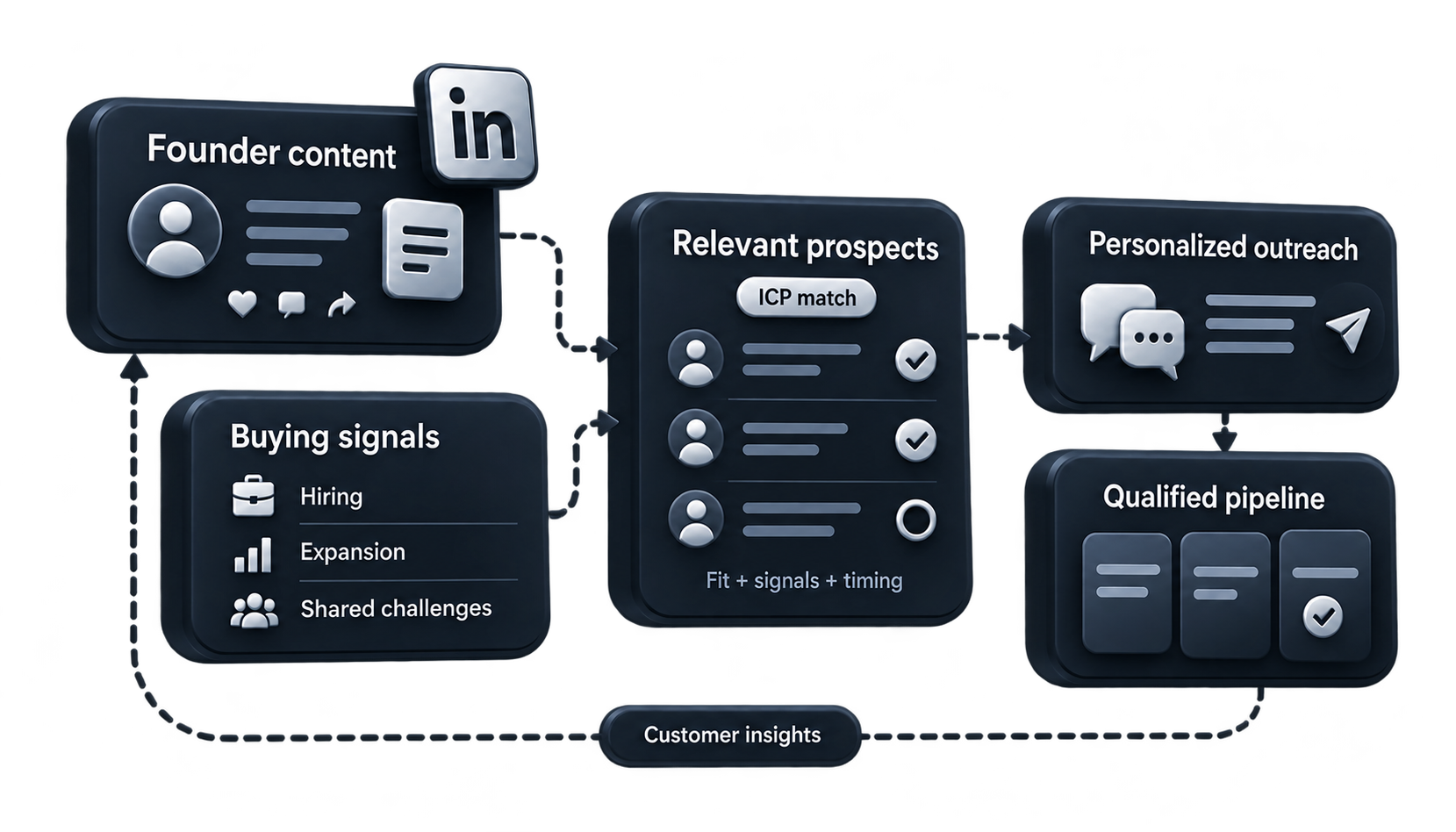
ICP tells you who could be a good customer. Buying signals provide clues about why the problem might matter now.
You need the first before the second becomes useful.
Turn Your ICP Into a Real Prospecting Filter
Let's put everything together.
Imagine you're building a B2B tool that helps small companies organize and scale their outbound prospecting.
Your first ICP could look like this:
Company characteristics:
- Industry: B2B SaaS or technology services.
- Company size: 5–20 employees.
- Business model: Sells products or services to other businesses.
- Sales process: Already uses outbound prospecting.
- Team structure: Founder-led sales or a small sales team.
Relevant decision-makers:
- Founder
- Co-Founder
- CEO
- Head of Sales
Potential problems:
- Too much time spent researching prospects.
- Difficulty identifying relevant decision-makers.
- Inconsistent follow-up processes.
- Limited capacity to increase outbound activity.
Signals worth investigating:
- Hiring an SDR or BDR.
- Announcing plans to expand sales operations.
- Discussing prospecting challenges publicly.
- Entering new B2B markets.
Possible exclusions:
- Companies with no outbound sales activity.
- Businesses without a relevant B2B offering.
- Organizations requiring unsupported enterprise functionality.
This is still a hypothesis.
But it's specific enough to guide your research.
You can use company databases, LinkedIn, public company information, and professional conversations to identify potential matches.
Not every criterion will be visible publicly. That's normal.
You don't need to know everything about a company before contacting it.
You need enough credible information to decide whether it's worth investigating further.
Don't Treat Every ICP Match Equally
Once you've built a list, another challenge appears.
What if 100 companies match your ICP?
Should you contact all of them in random order?
Probably not.
Some companies will match more of your criteria than others.
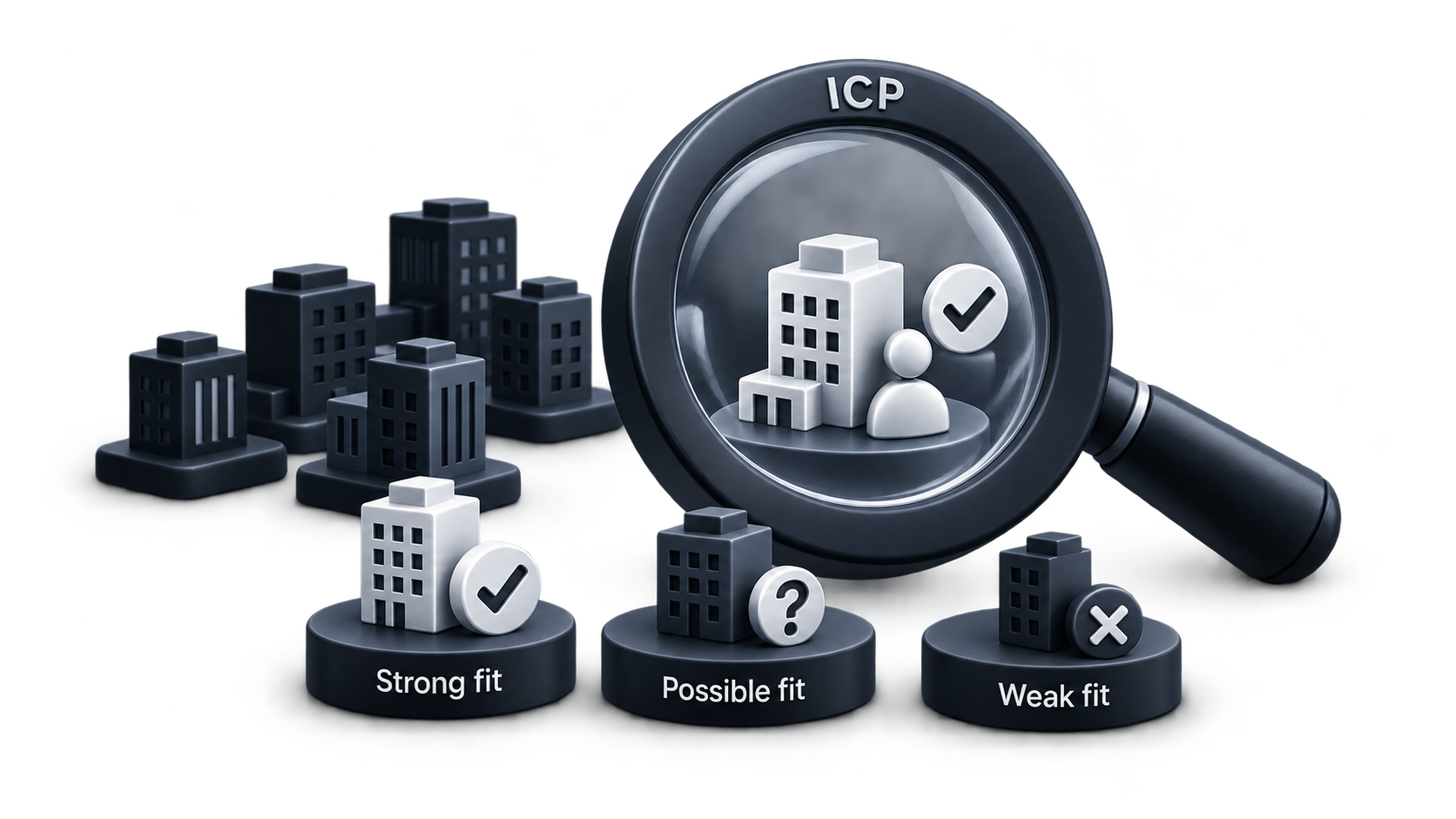
A useful approach is to distinguish between three levels of fit.
Strong fit: The company matches your core criteria, has a relevant problem, and there is credible evidence that the problem may be a current priority.
Possible fit: The company matches the basic characteristics, but you still need to understand whether the problem exists.
Weak fit: The company meets only broad criteria or has characteristics that make your solution unlikely to be useful.
This doesn't need to become a complicated scoring formula.
You could begin with a simple spreadsheet, review prospects manually, and prioritize the companies with the clearest reasons to explore your solution.
As your prospecting process grows, AI-assisted research and lead scoring can help organize that work.
For example, Sequently is designed to discover potential customers and rank them using customer fit and available buying signals.
That helps founders and sales teams focus their attention on more relevant prospects before reviewing messages and launching LinkedIn outreach.
But even with automation, your initial criteria matter.
A prospecting tool can help scale your research. It cannot automatically validate every assumption about who your ideal customer should be.
That understanding develops through real customer conversations.
How to Know Whether Your ICP Actually Works
Creating an ICP is not the finish line.
The real test begins when you use it.
One practical approach is to start with a small, focused group of prospects rather than a massive list.
For example, you could research 30–50 companies that match your initial ICP and evaluate whether they genuinely seem relevant.
Then begin appropriate, personalized outreach and track the results.
Pay attention to more than acceptance rates or total replies.
Ask:
- How many prospects match our criteria after closer review?
- How many responses suggest a relevant business problem?
- How many conversations turn into qualified meetings?
- What objections appear repeatedly?
- Which types of companies seem to get the most value from our solution?
The exact numbers you achieve will depend on your market, offer, outreach channel, and many other factors.
So don't treat a particular reply rate as universal proof that your ICP is right or wrong.
Look for patterns.
Use rejection as feedback
Not every negative response means your targeting failed.
Someone might be a good fit but have other priorities right now.
However, repeated responses such as “We don't do outbound” or “This isn't something our company needs” may suggest that your ICP is missing an important criterion.
That feedback is useful.
It can help you distinguish between companies that simply aren't ready to buy and companies that shouldn't have been on your list in the first place.
Improve one assumption at a time
Suppose your first audience is B2B SaaS founders with 5–20 employees.
You discover that companies with established outbound processes respond more positively than those still relying entirely on referrals.
That might be a reason to refine your ICP around existing outbound activity.
You can test the updated hypothesis with another group of prospects.
Over time, your ICP becomes more accurate because it's based on observed behavior rather than assumptions alone.
And as your product evolves, your ideal customer may change too.
That's expected.
An ICP should be a working document, not a description you write once and never revisit.
Final Thoughts: Better Prospecting Starts With Better Selection
Outbound sales becomes much harder when your target audience is too broad.
You can spend hours improving messages, experimenting with tools, and building larger prospect lists without addressing the underlying problem.
A useful ICP helps you focus on companies that have a realistic reason to benefit from your product.
Start with what you know. Identify the business problems you solve, the companies most likely to experience them, and the people responsible for addressing them.
Be clear about whom you should exclude.
Then test your assumptions through prospect research, conversations, and actual sales results.
You don't need a perfect ICP before starting outbound.
You need one that's specific enough to guide your decisions and flexible enough to improve as you learn.
Because successful prospecting isn't just about finding more people to contact.
It's about understanding which people are worth contacting in the first place.