
You make 100 calls. A handful of people answer, a few conversations end quickly, and one person agrees to a meeting.
It's tempting to judge the whole campaign by that single result.
But before rewriting your script or doubling your call volume, ask a more useful question: where are potential opportunities disappearing?
Are you struggling to reach people? Are the wrong people answering? Or are relevant conversations failing to produce a clear next step?
A cold-calling benchmark becomes useful when it helps you identify what to investigate.
Let's look at published research and turn the numbers into a practical way to improve your outbound process.
What Does a Cold Calling Success Rate Actually Measure?
Start with the denominator.
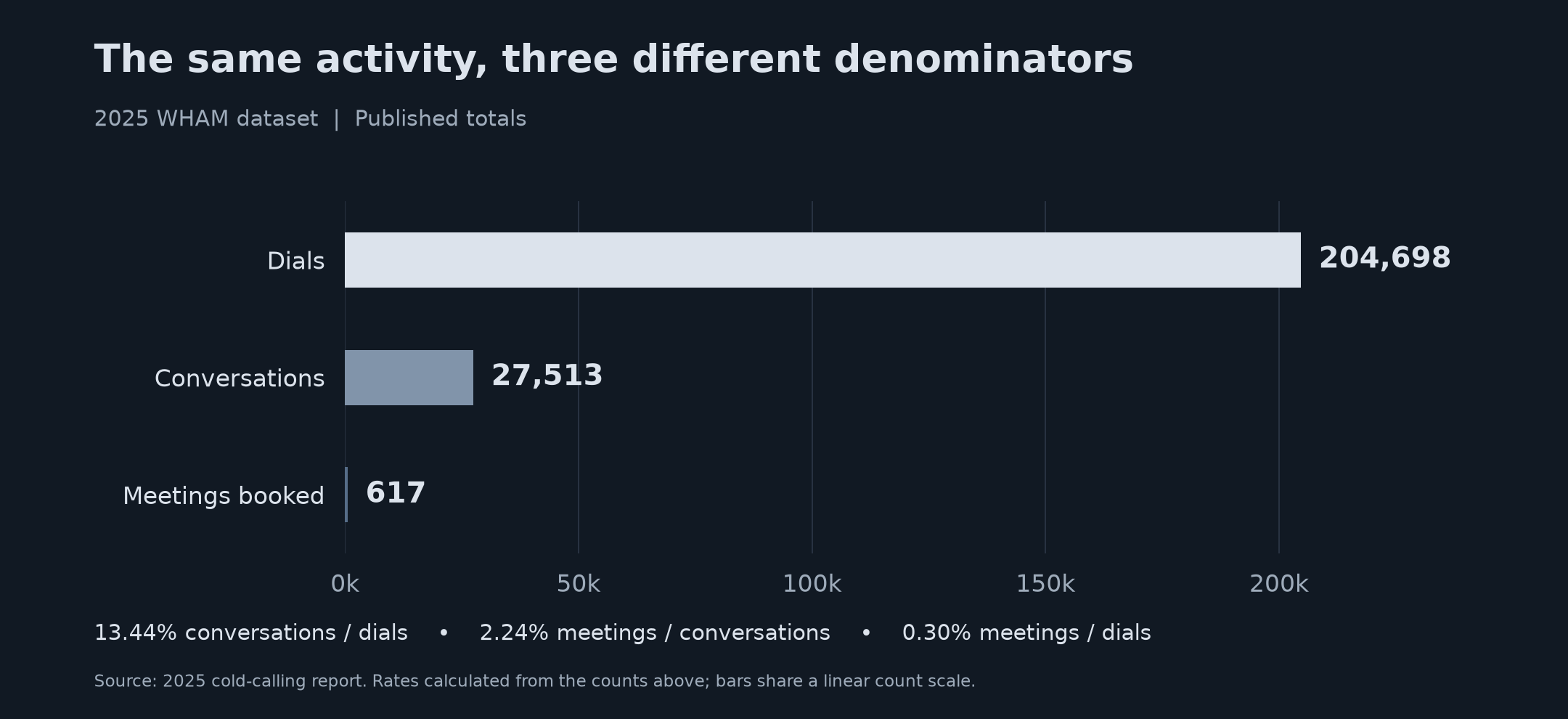
WHAM's published 2025 dataset covers 204,698 dials, 27,513 conversations, and 617 meetings.
Calculated from those counts, conversations represented 13.44% of dials. Meetings represented 2.24% of conversations, but only 0.30% of dials.
Those are three different measurements of the same dataset. The report's headline figure is 2.3%; the calculations here use its published counts.
Imagine comparing a team's meetings-per-conversation rate with another team's meetings-per-dial rate.
The first number could look dramatically better, even if both teams generated the same number of meetings from the same workload.
Keep each stage visible:
- Conversation rate: conversations divided by dials.
- Meeting conversion: meetings booked divided by conversations.
- Overall meeting yield: meetings booked divided by dials.
Also agree on what counts as a conversation. A brief answer, a discussion with a gatekeeper, and a useful exchange with the intended buyer aren't necessarily equivalent.
These figures describe one provider's activity, not a representative sample of every B2B sales team.
Why Can Two Teams Get Such Different Results?
A separate Gong and 30 Minutes to President's Club analysis of more than 300 million cold calls, published in 2024, reported the following:
| Measurement | Average reps | Top-quartile reps |
|---|---|---|
| Answered calls as a share of dials | 5.4% | 13.3% |
| Meetings as a share of connected calls | 4.6% | 16.7% |
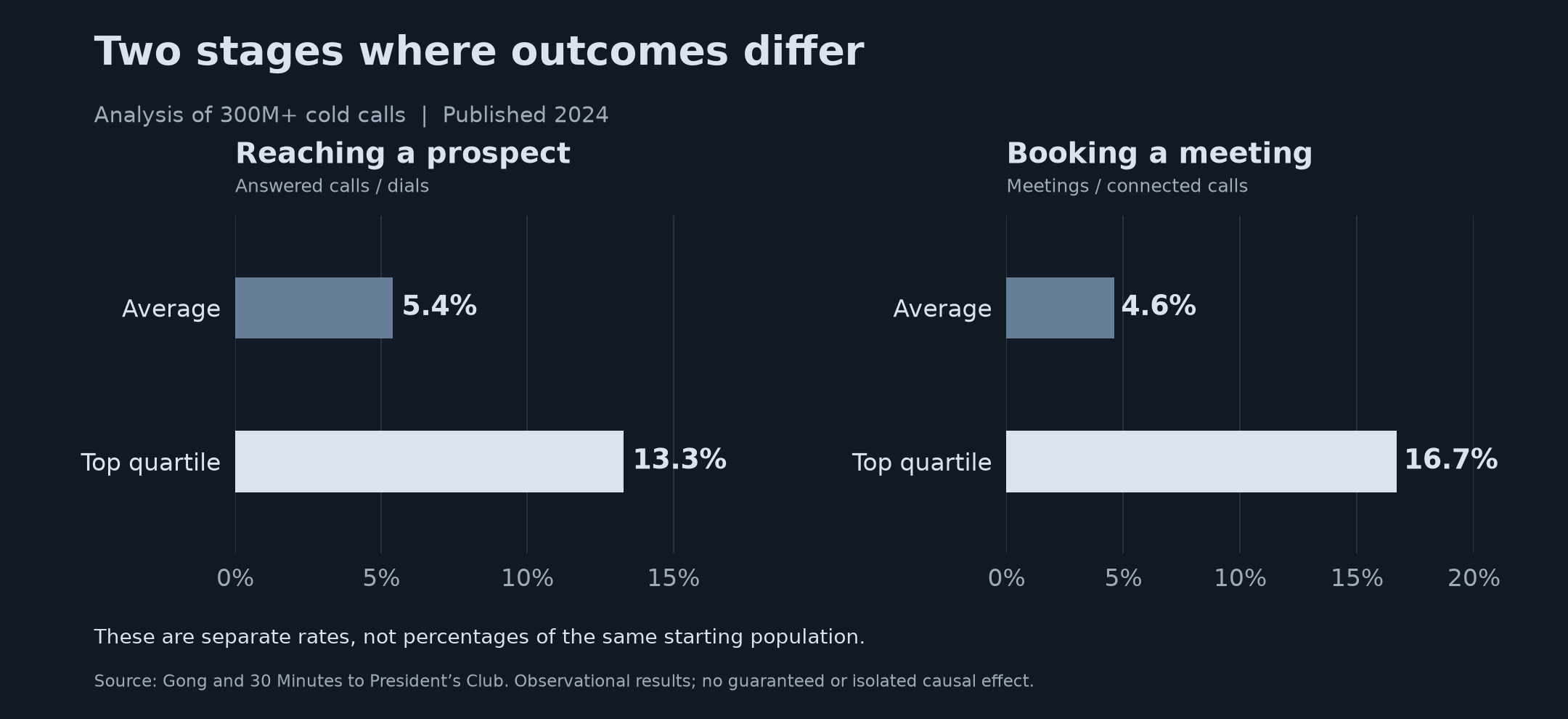
Both reaching someone and converting the resulting exchange differed. These observational comparisons don't isolate which individual tactic caused the gap.
For your team, the practical starting point is diagnosis.
If people rarely answer, review contact accuracy, role changes, and the hours you're calling in the recipient's time zone.
If people answer but rarely recognize the problem you're describing, review your audience selection.
If relevant prospects engage but won't commit to the next step, listen to how that step is proposed. Is its purpose clear? Does it address something the prospect actually mentioned?
Fix the stage that's failing before adding more activity to it.
A Better Call Often Starts With a Better Prospect List
Suppose your product helps small B2B teams manage prospect research.
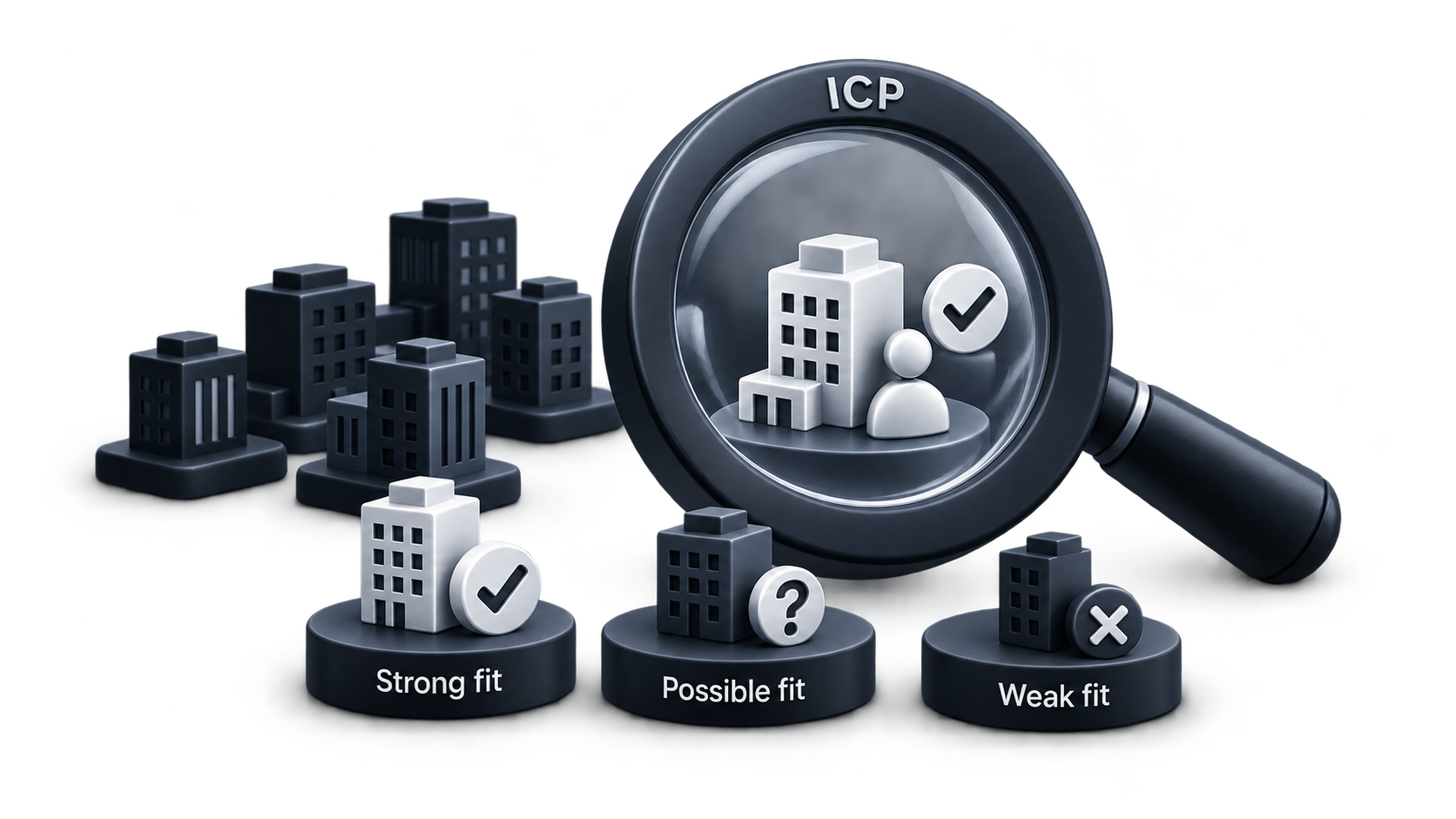
A list of founders at companies with fewer than 50 employees gives you somewhere to start. It doesn't tell you which founders need help now.
One founder might depend on a few long-standing referral partners. Another might be hiring a sales representative and trying to make prospecting more consistent.
Both match the company-size filter. Their reasons for taking your call could be very different.
Before adding someone to a call list, write down:
- Why their company could benefit from the product.
- Why this person is likely to understand or own the problem.
- What you have observed that makes a conversation timely.
A job posting or an expansion announcement can provide context. It doesn't prove the company has budget, wants your product, or is ready to buy.
Use that information to ask a better question, rather than presenting your research as a diagnosis.
For example, hiring a sales representative might justify asking how prospect research is currently handled. It doesn't justify assuming the process is broken.
Our guide to defining a useful ICP for B2B outbound explains how to turn broad customer descriptions into practical selection criteria.
Make the Opening Easy to Understand
The person answering your call hasn't read your campaign brief.
They need enough context to decide whether continuing is worthwhile.
In a separate 2024 analysis of cold-call openers, Gong reported an 11.18% success rate for a permission-based opening, compared with 2.15% for an opening that asked whether it was a bad time.
These are the study's reported success figures, not promised results for a script. Different audiences, offers, and execution can produce different outcomes.
A straightforward opening for our prospect-research example could be:
Hi Maya, this is Alex from ExampleCo. I saw you're hiring a sales representative. We help small B2B teams organize prospect research. Could I briefly explain why I thought this might be relevant, and you can tell me if I've misunderstood?
This is an illustrative example, not a tested script.
It identifies the caller, explains the observation, and gives the prospect a clear choice.
If they continue, ask how the work is handled today. You may discover that the company has a good process already, that someone else owns it, or that the problem exists but isn't a priority.
Each answer helps you make a better decision about what should happen next.
How Many Times Should You Try Calling?
The distribution of conversations in WHAM's 2025 data shows that 93% of recorded conversations occurred by the third attempt, rising to 98.6% by the fifth. These percentages describe the distribution of conversations that happened, not the likelihood that any individual prospect will answer.
That distinction matters when planning follow-ups.
A recipient who explicitly asks for a call next month is different from someone who has never answered. A wrong number should be corrected, not dialed repeatedly.
Record the outcome of each attempt so the next action reflects what you learned.
Useful outcomes include an incorrect contact, a request for more information, a specific callback time, a clear rejection, or a discussion worth continuing.
Decide in advance when an unanswered account leaves the active sequence. Your team can then review whether later attempts produce useful results rather than continuing simply because the next call is scheduled.
Respect requests to stop, and check the calling, privacy, and suppression-list requirements that apply to your recipients.
Give Each Channel a Clear Purpose
The phone doesn't have to carry the entire conversation.
The same Gong analysis reported email reply rates of 3.44% with cold calls versus 1.81% without, including situations without a live connection. This association doesn't establish that adding calls alone caused the difference.
Think about how each contact helps the recipient understand why you're reaching out.
If someone asks for an email, send the specific information they requested. If they agree to a callback, record when and what they want to discuss.
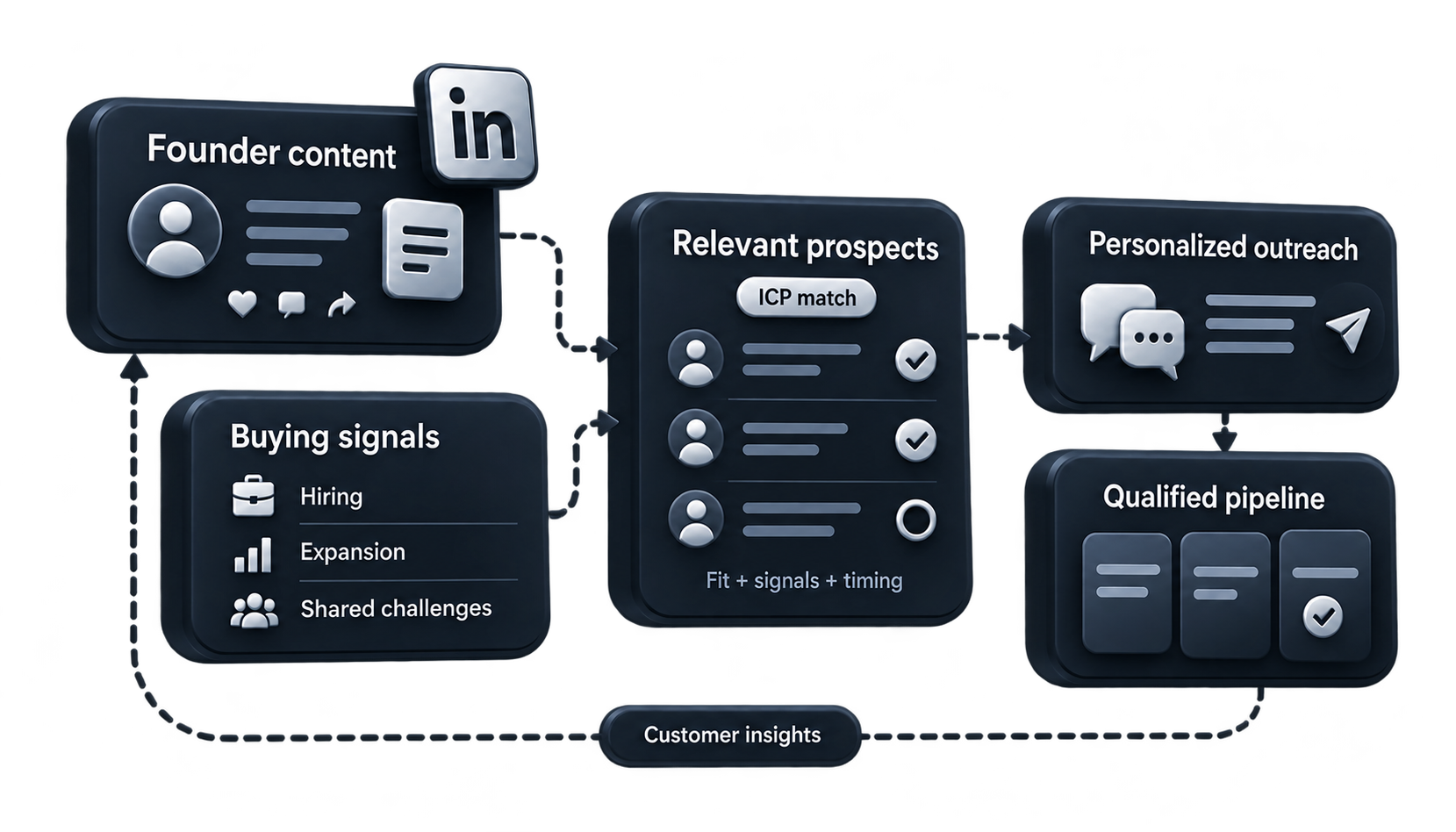
A LinkedIn profile can help explain who you are, but a connection acceptance doesn't automatically invite contact on every other channel.
Consistency matters: the company, problem, and reason for contacting someone should still make sense when they move from a call to your profile or website.
Our article on connecting LinkedIn content with qualified pipeline explores that relationship in more detail.
Measure What Happens After the Meeting Is Booked
A calendar invitation is an intermediate result.
Someone may accept without understanding the purpose, miss the meeting, or attend and discover that the product doesn't fit.
Earlier research offers useful context. RAIN Group's 2018 prospecting study, involving 488 B2B buyers and 489 sellers, reported that 82% of buyers accepted meetings from proactive sellers. It also found 58% of sales meetings weren't valuable to buyers.
The buyer-level acceptance statistic isn't an 82% conversion rate for calls. And these are historical survey findings, not a current market benchmark.
For a small B2B team, a useful scorecard includes:
- How many intended contacts you reached.
- How many conversations revealed a relevant need.
- How many agreed meetings actually happened.
- How many attended meetings became qualified opportunities.
Review those results by audience segment, not just across the whole campaign.
For example, separate founders building their first sales process from established teams replacing an existing tool. If their needs differ, the same opening and next step may not suit both.
Start with a manageable test and change one meaningful element at a time. Keep enough context in your notes to explain the numbers.
With a small sample, a change from one meeting to two can look like a dramatic improvement. It may still be noise. Look for repeatable patterns before expanding the campaign.
A productive call leaves you with a better understanding of the account, even when the right next step is to stop.
Final Thoughts
Cold-calling research can help you ask better questions about your outbound process.
Agree on what each metric measures. Check whether you're contacting relevant people. Make the reason for your call understandable, and follow through on the next step the prospect actually wants.
Then look beyond booked meetings to attendance, customer fit, and qualified opportunities.
The goal is a calling process that earns useful conversations and helps your team recognize where a real opportunity exists.