

When a cold calling campaign produces fewer meetings than expected, the easiest response is to increase activity.
Add more prospects. Make more attempts. Ask the team to push harder.
But more activity can repeat the same problem at a larger scale. A list full of irrelevant contacts will not improve because you finish it faster. An unclear reason for calling will still be unclear on the fifth attempt.
Before increasing volume, identify where the campaign stops making progress. In this article, we look at selected published calling data and build a practical way to diagnose your own results. The goal is to leave each review with a specific change you can test.
1. Separate the problems hidden inside your meeting count
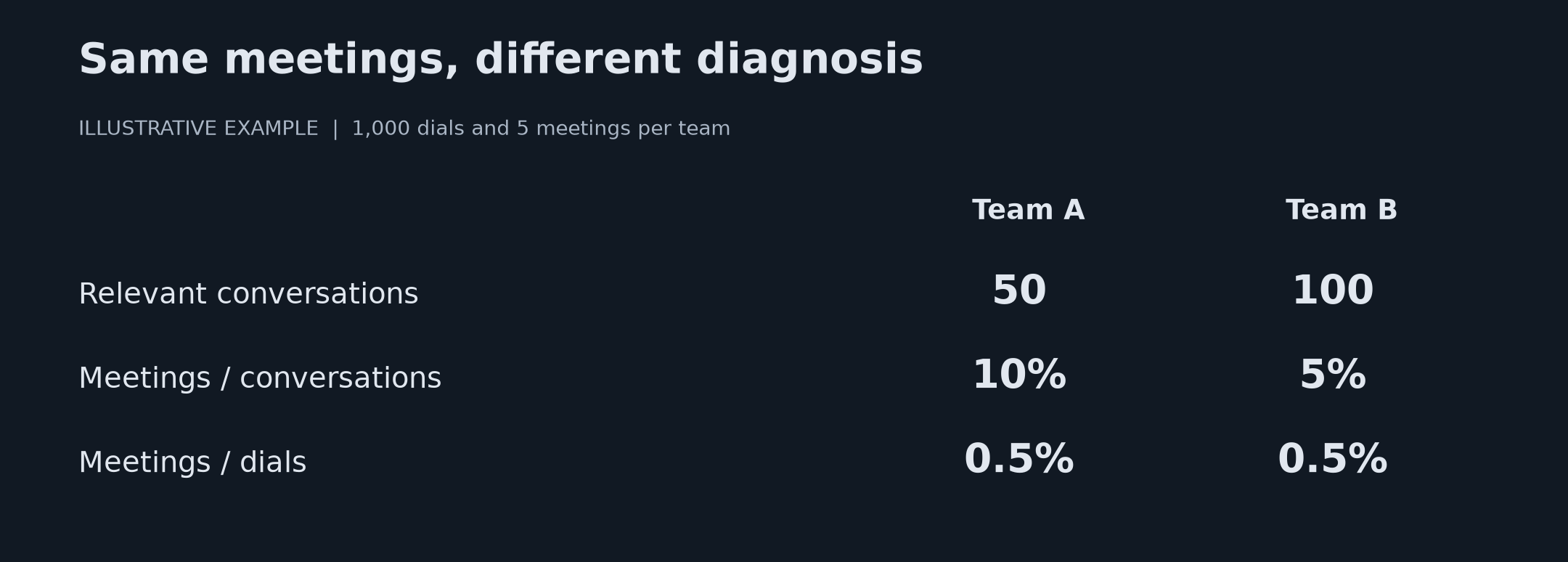
Imagine two teams that each make 1,000 calls and book five meetings.
The first team has 50 conversations. The second has 100. Their final result looks identical, but the work needed to improve it is different.
The first converts 10% of conversations into meetings. The second converts 5%. Both book a meeting on 0.5% of dials. These are illustrative numbers, not research findings or performance targets.
For the first team, reaching more relevant people may be the strongest opportunity. For the second, it is worth examining audience fit, the opening, and the reason someone would accept a next step.
Define a conversation consistently. An answered call routed through reception is not necessarily a conversation with the intended prospect. If your definition changes between weeks, the apparent improvement may be a reporting change.
Start with dials, relevant conversations, meetings booked, meetings held, and qualified opportunities. Keep the underlying counts next to the rates so a small sample does not look more convincing than it is.
2. Check your audience before rewriting the opening
If people repeatedly tell you that the problem is outside their responsibilities, your script may be doing exactly what it should: revealing a targeting mistake.
Review a small selection of contacts from the campaign. For each one, write a plain explanation of why the company might need your offer and why this person would care.
A job title is a useful clue. It is not a complete buying situation.
For example, a company hiring its first regional sales team may face different challenges from an established business replacing a sales leader. Both might have someone with the same title, but the relevant conversation will be different.
Use a useful ideal customer profile to narrow the audience. Then separate verified observations from assumptions. Hiring is observable. An urgent need to buy your product is an assumption until the prospect confirms it.
A good list gives you a credible question to ask. It should not force you to invent a problem for every person on it.
3. Make the first exchange useful enough to continue
A published 2025 calling report recorded an average call duration of around 93 seconds. That describes one dataset; it is not a recommended script length or evidence that longer calls perform better.
Your first exchange needs to establish enough context for the prospect to decide whether a conversation makes sense.
A practical opening has your name, the reason for the call, and one question connected to that reason. Leave the product tour for a conversation in which someone has expressed a relevant need.
For example:
“Hi Alex, this is Sam. I noticed you’re recruiting account executives for a new region. How are you deciding which accounts that team should approach first?”
This is a sample opening, not a tested winning script. Its usefulness comes from a real observation and a question the person can answer. If the observation is wrong, or the topic belongs to someone else, you learn that early.
When reviewing calls, look for the point where the exchange becomes generic. Did the salesperson acknowledge the answer, or move straight into the prepared pitch? Did they ask for a meeting before establishing what it would accomplish?
Change one part of the opening at a time. Otherwise, you will struggle to understand which change helped.
4. Treat repeat attempts as a resource decision
In the same published dataset, 93% of recorded conversations occurred within the first three attempts, rising to 98.6% within five. These percentages describe the distribution of conversations that happened. They do not mean that 93% of all prospects answered.
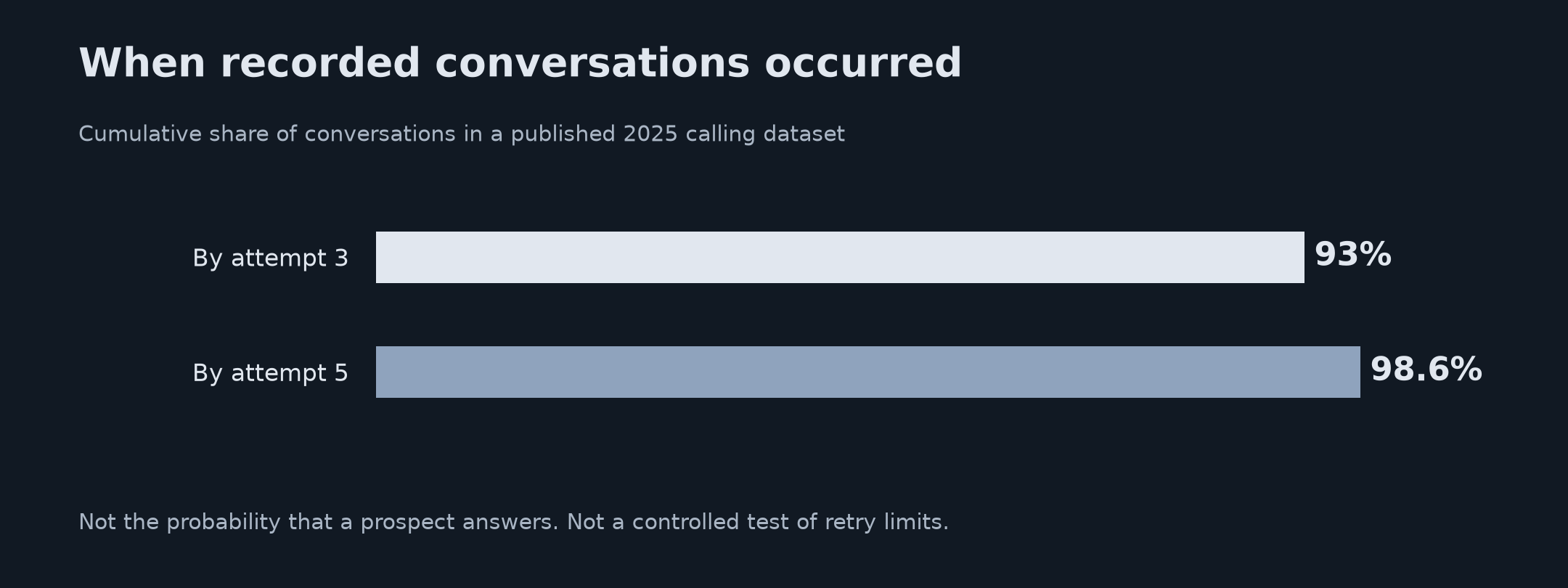
Use that distinction when deciding whether another attempt is worthwhile.
Someone who asked you to call next Thursday is different from someone who has never answered. Someone who clearly declined should not remain in a generic retry sequence.
Keep those outcomes separate. For unanswered calls, review the additional conversations and useful next steps produced by each attempt number. If later attempts consume substantial time while adding little, test a shorter sequence for comparable prospects.
You might also change the calling window or wait for a new reason to reach out. Repetition alone does not create relevance.
Set a stopping rule before starting the campaign. Make room for agreed callbacks, and respect requests to stop contact. This keeps persistence tied to context rather than a target number of touches.
5. Turn objections into information you can use
An objection is not automatically a challenge to overcome. Sometimes it is an accurate explanation of why the prospect should not buy.
Instead of putting every rejection into “not interested,” record what you actually learned:
- The person does not own the problem.
- The company does not have the need you expected.
- The need exists, but another priority comes first.
- The current solution is working well enough.
- The person wants to continue at a different time or through another channel.
Those outcomes suggest different actions. The wrong contact calls for better research. An absent need calls for a closer look at your targeting hypothesis. A timing issue may justify an agreed future conversation.
When someone asks for information, clarify what would be useful if they are willing to explain. Send the material that answers that question. Do not treat an email request as proof that a meeting is likely.
Review patterns across a comparable group of prospects. One difficult call can reflect a difficult moment. Repeated feedback about the same mismatch deserves a campaign change.
6. Connect the call to the rest of the buying journey
A phone conversation often creates a question that the buyer answers somewhere else.
They may visit your website, check your LinkedIn profile, share an article with a colleague, or compare your explanation with their current process. Make those next steps useful.
McKinsey’s 2024 B2B Pulse survey collected responses from nearly 4,000 decision makers across 13 countries. Respondents used an average of ten interaction channels across their buying journey. That is research about purchasing behavior, not a recommendation to contact each prospect through ten channels.
For a small outbound team, the practical implication is continuity. Your LinkedIn profile should explain the same problem you discuss on calls. A follow-up should reflect what the prospect said. A meeting invitation should state what both sides will explore.
For example, if someone mentions inconsistent account selection, send a relevant guide with a short explanation of the section that addresses their question. Sending a general product deck may add work without answering it.
Keep notes accessible to whoever handles the next conversation. The prospect should not have to reconstruct the context because a different person picked up the lead.
7. Run a campaign review that ends with one decision
A useful review connects the numbers with actual conversations. Start with a comparable audience and a defined period, rather than blending every region and role into one average.
Then choose the earliest stage where progress appears weak.
If relevant conversations are scarce, inspect contact accuracy, audience selection, and calling windows. If conversations happen but rarely lead anywhere, examine the need, the opening, and the proposed next step. If meetings are booked but not held, review expectations and confirmation.
Write the experiment in a sentence:
“For the next comparable group of accounts, we will change the opening question while keeping the audience and calling windows consistent.”
Choose a primary measure before starting, and retain the counts behind it. Also check the quality of the meetings that result. An opening that generates more calendar invitations but fewer relevant discussions may not be an improvement.
A scheduled review date is useful, but it does not make a small sample conclusive. If there are only a few conversations, collect more evidence before treating the difference as a reliable pattern.
The output of the review should be a decision you can explain: keep the approach, test a specific change, or stop spending time on a segment that does not fit.
Final Thoughts
Cold calling becomes easier to improve when you can describe what is happening between the first dial and the next useful conversation.
Use published figures as context. Use your own definitions, counts, and prospect feedback to decide what deserves attention.
Before asking the team for more calls, identify the problem those additional calls are supposed to solve. A more precise audience, a clearer question, or a better agreed next step may be the more useful change.