

You send a connection request. The prospect accepts. A few days later, your message is still unanswered.
Did the outreach work?
That depends on what you wanted the acceptance to achieve. It opened a channel, but it didn't establish a need, start a useful conversation, or create a sales opportunity.
A benchmark is most useful when it helps you decide what to investigate next.
We reviewed published outreach data to explore that distinction. Here is how to use the numbers without letting an average replace your judgment about a prospect.
Start with measures you can actually compare
A published platform dataset covers 13.2 million connection requests and 6.7 million outbound messages across 13,302 accounts, from May 2025 to April 2026. It reports 28.5% acceptance, 10.4% message replies, and 3.0% connection note responses.
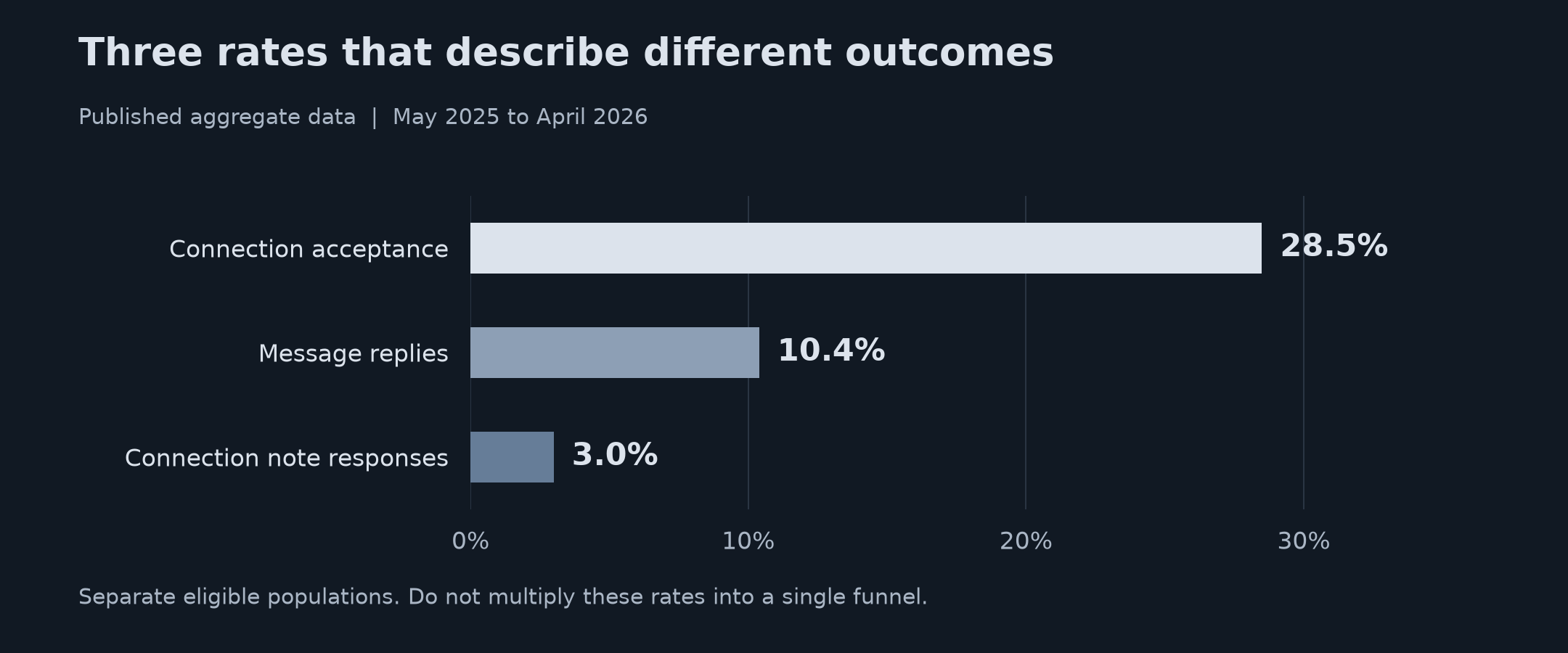
These observations are a reference point, not a representative estimate for every B2B team. We are interpreting published aggregates; we did not collect the underlying campaigns.
Before comparing your results, write down the calculation your team uses. Does reply rate count unique people who answered, or replies to individual messages? Are connection notes included? How long do recipients have to respond?
Suppose one dashboard counts a prospect once across an entire sequence, while another records replies against each message sent. Their percentages can differ even when they describe the same conversations.
Choose a reporting window and keep the definitions stable. Otherwise, a change in measurement can look like a change in performance.
Use your audience as the starting point
Imagine two teams contacting founders at small software companies.
The first builds its list from industry and employee count. The second looks for companies hiring their first salesperson, then checks whether prospect research is likely to sit with the founder.
Both lists fit the same broad company description. The second team has a clearer reason to ask a specific question.
That observation still needs testing. Hiring someone doesn't prove that research is a problem or that a purchase is planned. It gives the sender a useful starting point for a conversation.
Review a small sample of intended contacts before changing the copy. Can you explain why each company might benefit, why this person would care, and what you have actually observed?
If those answers are weak, adding another personalized opening line is unlikely to resolve the underlying uncertainty.
Our guide to defining a useful ICP for B2B outbound provides a practical way to make those selection decisions explicit.
Give each message a reason to exist
A separate observational comparison covered 2,966 campaigns. Reported reply rates were 6.3% for one message, 6.8% for two, 9.8% for three, 7.9% for four, and 5.0% for five or more.
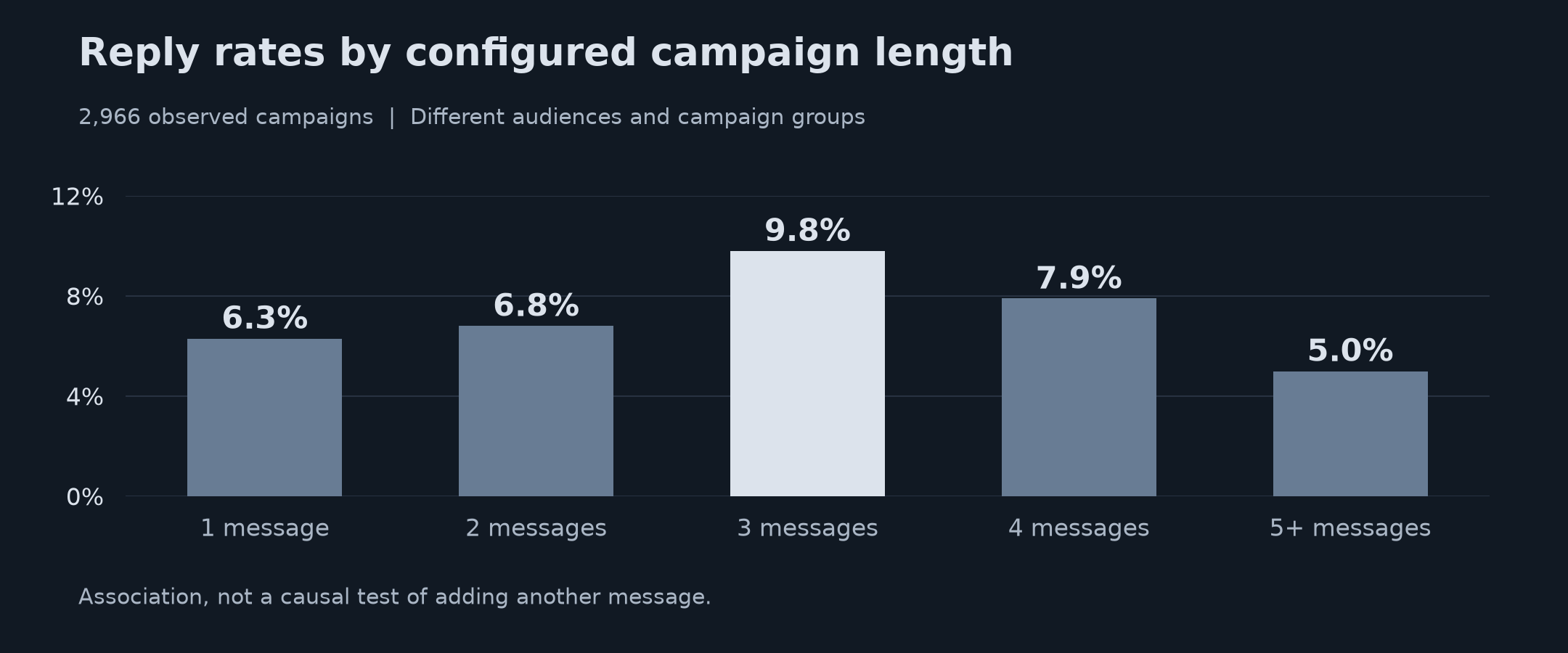
It would be a mistake to read that pattern as proof that an extra follow up causes fewer replies. Longer campaigns may have reached harder audiences or used different offers. Campaign configuration also differs from the number of messages each person actually received.
For your team, a better question is what the next message contributes.
A simple sequence might include:
- An introduction: explain the relevant context and make the connection request understandable.
- A conversation starter: ask about a problem the recipient is likely to recognize.
- A useful follow up: add a concrete example, clarify your question, or give the person an easy way to close the conversation.
This is a starting structure to test, not a requirement to send every step. A reply, rejection, or request to stop should change what happens next.
Read the messages together before launching. If removing a follow up changes nothing about what the prospect learns, that step probably needs more thought.
Make the message easy to understand
A prospect should be able to identify why you contacted them without reading a paragraph about your company first.
Consider this illustrative message:
Hi Maya, I noticed you're hiring your first salesperson. How are you planning to divide prospect research between the new hire and the founding team?
It introduces an observation and asks one understandable question. It also leaves room for the prospect to say that the work is already handled well.
Compare that with a message that lists every feature, praises the recipient's background, and asks for a meeting before explaining the relevance.
The editing task is to remove what the reader doesn't need yet.
LinkedIn's own 2022 research found that InMails under 400 characters had response rates 22% higher than the overall average. That is a relative difference, not a 22% response rate. The analysis concerned corporate recruiting InMails sent between May 2021 and April 2022, not today's sales messages to existing connections.
The finding supports testing concise writing. It doesn't establish a universal character limit for your audience or validate another dataset's absolute reply rate.
Start by checking whether the message contains one relevant observation, one clear reason for contacting the person, and a question they can answer without doing research for you.
Use AI to improve a draft you can explain
AI can help shorten a long introduction or generate alternative ways to ask a question. The sender still needs to verify the facts and decide whether the question belongs in the conversation.
For example, a company announcing an expansion may be exploring a new market. It doesn't follow that its current sales process is failing.
If a draft turns the announcement into that assumption, it has moved beyond the evidence.
Before approving a message, check:
- Can you point to the source of the observation?
- Does the message distinguish what you know from what you are asking?
- Would the wording still make sense if the prospect had already solved the problem?
Remove praise you couldn't explain in a normal conversation. Replace invented certainty with a question. Read the final version aloud to check whether it sounds like something you would actually say.
When testing AI assistance, hold the audience and offer reasonably steady. Comparing an AI draft sent to unfamiliar accounts with your usual copy sent to existing followers would tell you little about writing quality.
Test timing without changing everything else
It is tempting to find a best day or hour and apply it to every campaign. A useful scheduling test needs more context.
First, establish which time zone the timestamps represent. A morning send on a server clock may reach a prospect after their working day has ended.
Then separate the time a request was sent from the time it was accepted or answered. A recipient can read a message later, so a send-time chart is not necessarily a chart of when people want conversations.
For a practical test, divide a comparable audience between two reasonable working-hour windows. Keep the message, offer, and observation period consistent. Record the recipient's region so results aren't mixed together without context.
Allow both groups the same time to respond before drawing conclusions.
If you only have a small number of contacts, concentrate on learning why people respond. A few additional replies can make a percentage move substantially without establishing a repeatable scheduling advantage.
Connect replies to the next useful decision
A reply can mean interest, a referral, a polite rejection, or a request to stop. Counting all of them together hides information your team needs.
Track the conversation outcome alongside the headline rate:
- Did you reach the intended person?
- Did they recognize a relevant need?
- Was there an agreed next step?
- Did an attended meeting become a qualified opportunity?
Here is a hypothetical example. Two campaigns each contact 100 prospects. One receives 12 replies and produces no relevant next steps. The other receives six replies, including two introductions to the right decision-makers.
The lower reply rate may be more useful to the business. That conclusion comes from examining the conversations, not from choosing a different benchmark.
Keep a short reason for each outcome. A note such as “problem exists, review planned next quarter” is more actionable than classifying every response as simply positive or negative.
Our article on connecting LinkedIn content with qualified pipeline explores how those observations can inform your next prospecting decision.
Final thoughts
Use outreach benchmarks to decide where to look more closely.
Define your measures, examine the audience, and give each message a clear purpose. Test changes under comparable conditions, then review what the resulting conversations actually revealed.
The most useful improvement is one your team can explain, repeat, and connect to a real customer need.